Bling bling
now everyone can b beautiful
Sunday, March 2, 2008

Sunday, February 17, 2008
Pecorino and Pecorino Romano
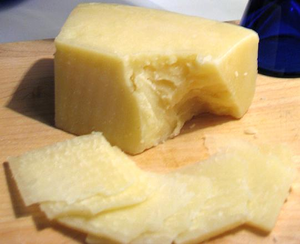 From the wiki
Pecorino is the name of a family of hard Italian cheeses made from sheep's milk. The word pecora, from which the name derives, means sheep. Most are aged and sharp.
Of the four main varieties of mature pecorino, all of which have Protected Designation of Origin (PDO) status under European Union law, Pecorino Romano is probably the best known outside Italy, especially in the United States which has been an important export market for the cheese since the 19th century.[1] Most Pecorino Romano is produced on the island of Sardinia, though its production is also allowed in Lazio and in the Tuscan Province of Grosseto.
The other three mature PDO cheeses are the milder Pecorino Sardo from Sardinia; Pecorino Toscano, the Tuscan relative of Pecorino Sardo; and Pecorino Siciliano (or Picurinu Sicilianu in Sicilian) from Sicily. All come in a variety of styles depending on how long they have been matured. The more matured cheeses, referred to as stagionato, are harder and have a stronger flavour. Some varieties may have spices included in the cheese. In Sardinia, the larvae of the cheese fly are intentionally introduced into Pecorino Sardo to produce a local delicacy called casu marzu.
Pecorino Romano is most often used on pasta dishes, like the better-known Parmigiano Reggiano (parmesan). Its distinctive strong, very salty flavour means that it is preferred for some pasta dishes with highly-flavoured sauces, especially those of Roman origin, such as pasta all'amatriciana.
Pecorino Romano is a hard, salty Italian cheese, suitable primarily for grating, made out of sheep's milk (the word pecora, from which the name derives, means in fact sheep). Pecorino Romano was produced in Latium up to 1884 when, due to the prohibition issued by the city council of salting the cheese inside their shops in Rome, many producers moved to the island of Sardinia [1]. It is produced exclusively from the milk of sheep raised on the plains of Lazio and in Sardinia. Most of the cheese is now produced on the island, especially in Gavoi.
Pecorino Romano was a staple in the diet for the legionaries of ancient Rome. Today, it is still made according to the original recipe.
Pecorino Romano is most often used on pasta dishes, like the better-known Parmigiano Reggiano (parmesan). Its distinctive aromatic, pleasantly sharp, very salty flavour means that in Italian cuisine, it is preferred for some pasta dishes with highly-flavoured sauces, especially those of Roman origin, such as bucatini all'amatriciana. The sharpness depends on the period of maturation which varies from five months for a table cheese to at least eight months for a grating cheese.
Pecorino Romano should not be confused with Pecorino Toscano (from Tuscany) or Pecorino Sardo (from Sardinia). Unlike Pecorino Romano, these cheeses (which are not particularly salty) are generally eaten by themselves or in sandwiches.
Pecorino Romano cheese, whose method of production was first described by Latin authors like Varro and Pliny the Elder about 2000 years ago, was first created in the countryside around Rome. Pecorino Romano cheese is used mostly in Central and Southern Italy.
On the first of May Roman families traditionally eat Pecorino with fresh fava beans, during a daily excursion in the Campagna.
Thursday, January 24, 2008
Boiling water
Do I Need to Replace the Water in My Kettle?
Maybe boiling it twice makes it extra-good


Barry Swanson, PhD, a food science expert with the Institute of Food Technologists, explains that the oxygen in the water reacts with the aromatic compounds in tea and coffee to produce flavor. A greater concentration of minerals can give your drink a metallic tang.
“The ultimate reason is taste,” says Rich Avella, production manager, coffee and tea, for Peet’s Coffee & Tea. When you boil water over and over, “you lose some of the complex aromatics and details in flavor. When you get into quality teas and coffees—like food—you really enjoy those nuances.”
Lisa Boalt Richardson, president of the Southern Association of Tea Businesses, agrees that tea will taste flat if there isn’t enough oxygen in the water. She says when brewing tea to avoid distilled water, because it’s already been boiled to remove impurities.
Avella suggests an easy test, especially if you use very high-quality tea or coffee: Just brew two identical cups, one with freshly boiled water and another using twice-boiled water. Then do a side-by-side comparison, paying attention to the contrasts in flavor and aroma. “It’s easy to see the difference,” he says.

fr CHOW : http://www.chow.com/stories/10891
Agneau
A delicacy among the red meat lovers, agneau is ur answer to tender meat,for various religous purposes
1-all religions except those vegan can eat it
2-the animal sacrificed itself to the butcher's knife when its 30 to 40 days when the animal weighs between 8 to 10 kilograms (18 to 22 pounds)
n here is the best place to surf about it
http://www.hertzmann.com/articles/2005/agneau/
enjoy~!
1-all religions except those vegan can eat it
2-the animal sacrificed itself to the butcher's knife when its 30 to 40 days when the animal weighs between 8 to 10 kilograms (18 to 22 pounds)
n here is the best place to surf about it
http://www.hertzmann.com/articles/2005/agneau/
enjoy~!
Subscribe to:
Comments (Atom)